

A timeless science that teaches you to breathe with nature.
It opens the door to health, abundance and inner peace.
Richard Nemeth — Vastu and Sthapatya Veda teacher since 2017
The Revival of Sthapatya Veda—The Challenge and Opportunity of Our Time
Vaastu Shastra is now a globally recognized concept—the internet has greatly aided the dissemination of this ancient wisdom.
This science was passed down through generations of experience and centuries of research by the ancient Shilpis, yet over the past three centuries, under the influence of foreign rule and foreign cultures, it was forced to fall silent.
Yet India preserved it as a living tradition because of its profound values—and now, with the advancement of modern science, it is reawakening in new ways.
Researchers are increasingly investigating the invisible energies that surround us and live within us, including those preserved in the sacred Vaastu and Agama texts.
More and more people are realizing that the many illnesses, stress, and tensions afflicting the residents of modern homes are often rooted in the disregard for sacred spaces and the disarray of the living environment.
Meanwhile, Vastu consultants are mushrooming worldwide—some practice authentically, while unfortunately, many others do not.
The laboratories of modern science have yet to provide a logical, scientific answer to the problem of "sick buildings"—partly because very few can authentically interpret the technical content of traditional texts without linguistic and professional barriers.
This is precisely why a traditional practitioner, a Sthapati, has taken on this task—to pass down this wisdom from a pure source under the title of "Sthapatya Veda," the ancient, original name of Vastu science.
Vibration + Rhythm = Form
The Essence of Sthapatya Veda
Sthapatya Veda is the science of ancient architecture — not a style, but an exact system of how to create spaces that vibrate in harmony with us and the laws of nature.
It is simultaneously a science (Vaastu Veda, Vaastu Shaastra) and a technology (Vaastu Tantra) — meaning it is not just theory, but a functioning system applicable in practice.
To put it briefly: it is the science of energy, matter, time, space, and form — it is about the wonderful process of how subtle, invisible energies transform into physical, tangible form.
Vastu Shastra:
A Scientific Treatise, Not a Religious Document
Vastu and Agama are millennia-old, living cultural sciences that are not based on dogmas or religious beliefs.
Traditional Vedic architecture (Sthapatya Veda) is a highly advanced, exact natural science formulated in a precise technological language.
Sacred forms, the geometry of temples, residential buildings, and entire town planning are all rooted in a strict, unquestionable mathematical order governed by the immutable laws of Nature—not by individual whims or fancies.
Eastern sacred arts—including poetry, music, sculpture, and architecture—are all built upon the interconnectedness of "Energy and Matter" and "Time and Space."
Vastu science goes far beyond the frontiers of modern materialistic sciences. Its uniqueness lies in its ability to scientifically translate material prosperity, physical welfare, and the spiritual experience of bliss and inner peace into the language of structural spaces.
A Bridge Between Modern Physics and Millennia-Old Wisdom
Modern architecture, following Western paradigms, often focuses solely on surface-level, material ecology, while completely ignoring the subtle, spiritual environment of spaces.
This disarray results in unbalanced, high-stress, and draining living environments.
For the first time, this treatise illuminates the technological and ecological connections in a way that is perfectly intelligible to the modern mind:
-
The Oneness of Mass and Energy: Traditional Vastu wisdom validates and applies Albert Einstein’s famous equation (E=mc²) from the standpoint of sacred architecture. Matter and Energy are interconvertible qualities.
-
Sthapatya Veda: This very principle forms the bedrock of Sthapatya Veda—the establishment of peace, harmony, and prosperity on earth. This wisdom is an integral part of the Pranava Veda, handed down to humanity by the ancient sage Maya.
The millennia-old work of traditional designers and builders (the Shilpis and Sthapatis) does not exist to spin isolated, abstract theories.
The ultimate aim of Vastu science is to enable the human race to live in perfect harmony: not only with gross nature (matter) but with subtle nature (energy) as well.


The Secret of the Pyramids
7,83 Hz
Schumann Resonance — the Earth’s own "heartbeat"
Pyramid shapes and spaces built on sacred geometry do not calm us by accident.
Their frequency resonates with the Earth's own electromagnetic pulsation — the very same 7.83 Hz vibration that the human brain displays in a calm state.
Sthapatya Veda already applied this principle thousands of years ago — not with measuring instruments, but through a more subtle perception, tuning spaces to the rhythm of nature.
Sthapatya Veda or Vastu Vidya?
Many people use the two terms interchangeably today, even though they do not mean the same thing.
Sthapatya Veda is the complete, original system of knowledge — the unity of space, form, energy and cosmic order. Vastu Vidya is a simplified, narrower branch of it, which has become more widely known over time, while the deeper layer has been forgotten.
We strive to pass on the complete, original knowledge — not just the fragment known as Vastu Vidya.
The Pranava Veda and Mayan Heritage
The Sthapatya Veda system is based on the traditional art and technological principles of Vaastu Shaastra.
The ancient masters, the Sthapatis, called it the science of "MAYA" — a tribute to the genius of the legendary scientist and architect, Mayan, who lived in the ancient southern lands of the Kanyakumari region.
Divine Intelligence
The Lingam is the most ancient tool of Vedic sacred geometry endowed with the greatest subtle-physical power, embodying the primordial cosmic vibration of "OM" on the physical plane.
This majestic monolith operates as an intelligent, divine computer capable of precisely perceiving and realigning the energies of your space, while providing unshakeable, pure protection to its surroundings.

GUARDIAN OF MODERN TRADITION
Dr. V. Ganapati Sthapati
One of the most influential Sthapatis of the 20th century, he dedicated his entire life to preserving and passing on the pure knowledge of Vaastu Shaastra.
His favorite example is the Brihadeeswarar Temple in Thanjavur — a masterpiece of millennia-old Chola architecture that remains a living testament to the principles of the Sthapatya Veda.

The Lineage of Tradition: The Power of Commitment
Many view Vastu as an Indian-born knowledge meant "only for Indians." The reality, however, is that according to the greatest grandmasters of Sthapatya Veda, sacred knowledge does not depend on ancestry, but on pure transmission and deep dedication. Moreover, this knowledge itself is far older than any nation on Earth.
My journey within the tradition:
For 28 years, I have been immersed in the foundations and research of Vastu.
For 9 years, I have held the highest level of this science, which is when I earned my qualification in Temple Architecture (Sthapatya Veda).
For 9 years, I have been representing Europe—by the trust and authorization of my Indian masters.
Being a temple architect is the deepest, engineering, and sacred level of Vastu science.
It is not my origin that defines me, but the pure, undistorted knowledge received directly from the source, which I pass on here in Europe with the exact same humility.
Digging deeper:
TRADITIONAL SCIENCE AND TECHNOLOGY
In this age of highly developed science and technology, it seems incredible that India once possessed its own science, which underscored its superiority and uniqueness.
It lay dormant under foreign rule, but today—not only here, but throughout the world—it has been spectacularly reborn!
This science is briefly called the science of energy and matter, time, space, and spatial form, and is essentially the science of subtle energy being transformed into gross or embodied energy, also called material form.
One could add that it is the science of sound and light, as well as of the word and its meaning, from which material forms such as house architecture, temple architecture, urban planning, and other imaginary forms arise.
All of this is space-centered, but not religious or sectarian, as many mistakenly assume.
It can be described as the science of the manifestation of energy in the form of matter. It also led to the discovery that the universe follows a mathematical formula and that architecture is a manifestation of this formula.
The science is based on the technological principles and processes of the traditional art and architecture of Vaastu Shastra.
This ancient science is called by the Sthapatis Maya Science and Technology, not only to distinguish it from modern materials science, but also to revive and cultivate the unique humanities of a great scientist and engineer, Maya.
Maya lived in the southern region of Kanyakumari—present-day Kumari.
This landmass was known as நாவலந்தீவு (Jambudweepam). According to the teaching of Ganapati Sthapati and tradition, this area existed during the Sangam era, even before 10,000 BCE.
The benefits of the science of Vastu
it was used all over the world in the past.


Who does not know those three fundamental shapes that have formed the rock-solid foundation of all human architecture for millennia?
The universal power and geometric order of the square, the octagon, and the circle proclaim exactly the same law in every culture and in every language.
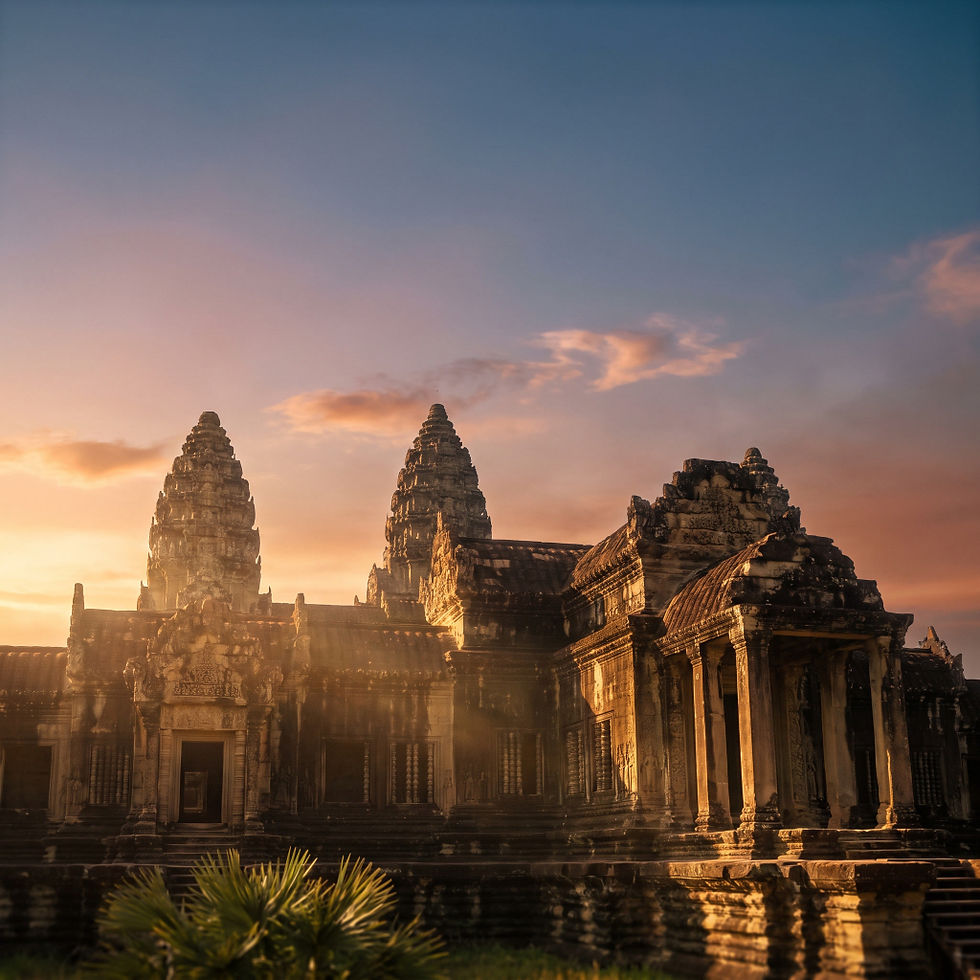
You don't need to travel far for the higher science of architecture, since the cosmic laws of nature are present in many era-defining buildings.
I have personally examined and surveyed the parliament buildings of several countries – including, in detail, the Hungarian Parliament Building – and in these too, the principles of Vastu can clearly be recognized.
The construction, design language, and structure of most parliaments still reflect the principles of Vastu today.
Humanity has always known this power: if we look back six thousand years to the Sumerian culture, we can see that the temple itself was the heart and engine of the state, creating the so-called temple economy.
During my research, I also found fascinating examples of this conscious building in Greece.
Numerous buildings that align with Vastu principles still stand here today: among them the Acropolis in Athens and the Temple of Apollo in Delphi.
Archaeology identifies the temple's central stone (the omphalos) according to Greek tradition – however, according to my own on-site research and the confirmation of my Indian masters, it fulfills the same sacred role as the Lingam does in the Vastu tradition.
Although many ancient temples have lost their original function today and we view them merely as religious monuments, they still preserve the deep laws of nature in their structure. It is an interesting living tradition that the first slice of the blessed, traditional New Year's cake is always given to the house, and only then to the family members – this also demonstrates the deep respect toward the home.
The Asklepieion (Asklepieia) is an excellent example of this too, linked to Hippocrates, the father of medicine. According to the Cypriot healer Daskalos, these sanctuaries worked in a deeper way than is traditionally known: they also drew on the space's particular healing power and pure vibration as part of the healing process – a view we ourselves share.
Indeed, a space built according to the principles of Vastu is capable of generating a resonance that positively retunes the cells of the human body. This higher frequency triggers the body's self-healing processes and restores inner balance in a natural way.
As part of my research, I also personally surveyed the entire building complex of the Vatican, and the results showed close alignment with Vastu principles.
It is no coincidence that Dr. Prasanna Kumar Acharya's research (Oxford University Press, 1933) found numerous close similarities between the work of the famous ancient Roman architect Marcus Vitruvius Pollio and the Indian Manasara Vaastu Shastra – principles that Leonardo da Vinci also discovered and elevated to a new level centuries later.
The brilliant 20th-century French architect Le Corbusier likewise explored the invisible connections between Space, Time, and Rhythm, and built them into his revolutionary works.
The Taj Mahal in India and countless magnificent European castles also reflect this tradition.
The White House in Washington has been examined by great Vastu masters, who found numerous correspondences between the building's structure and effect and the principles of Vastu.
This knowledge stands above borders and eras.
For what purpose were the pyramids built?

Pyramids can be found at almost every point of the world in countless ancient cultures.
Their true purpose was to generate life-giving frequencies that fine-tune the environment, supporting life and positive events.
These monumental structures usually resonated in the range between 7.83 Hz and 12 Hz, but there were also those that exerted their effect in the field between 2 Hz and 12 Hz.
The fundamental vibration of our planet Earth (the Schumann resonance) hovers around 7.83 Hz – this is the frequency that makes life possible in the first place. Meanwhile, deep within an untouched rainforest, a 12 Hz vibration dominates, filling everyone with an instant sense of well-being and vital energy.
The pyramids tuned to lower frequencies were specifically designed for healing.
The ancient architects knew exactly that the human brain and nervous system need these deep vibrations to harmonize the hormonal balance and ensure the perfect functioning of the body.
The pituitary gland (hypophysis) is actually the conductor of your entire organism.
It needs a vibration of about 5 Hz to function perfectly.
If this fine-tuning falls out of balance, the system of the physical body begins to decline over time.
This tiny organ and the rhythm of internal time determine your well-being – in fact, we can say, your destiny as well.
For the number and rhythm of frequencies are closely linked to the passage of time, which regulates not only the aging processes but your daily vitality too.
We humans sleep and meditate so that our bodies can access these vital, deep frequencies.
The pyramids formed a global network, protecting the planet like a shield from negative cosmic influences.
This was the Golden Age: the elevated vibration level brought higher intelligence to all living beings and structurally purified the waters, which make up more than 70% of our planet and our bodies.
No electronics were needed for any of this.
Only the precise location, size, material, and sacred form of the pyramids brought the invisible, healing power of space into action.
Sthapatya Veda or Vastu?

This science is older than any religion, so ancient temples were not originally built for religious purposes.
Although few know it, this knowledge was the fundamental pillar of the most advanced civilizations.
The temple and pyramid complexes provided that higher-order fundamental quality that ensured the harmonious functioning of society.
These sacred structures created the life-giving energy, which was further expanded through the orderly design of the environment, until thriving cities eventually evolved from them.
Sthapatya Veda means: ARCHITECTURAL SCIENCE.
Vastu means: CONSCIOUSNESS and is also the building block of this science (Energy).
Everything is built from energy. This science applies the creation concept of the Universe: it starts from the premise that the visible and invisible world unfolds from a single starting point according to universal laws.
Since everything in existence – whether a building, a city, music, dance, or poetry – follows the same rhythmic life cycle, it feeds from a single common source.
The chief director of this process is Time. Time shapes space, determines distance, and thereby Time becomes the key to this science and to entire existence.
Our planet was made livable by the perfect proportion of the 8 primal elements – fire, earth, water, air, space, time, sound and light.
The same rhythm and system of proportions determine the functioning of plants, animals, and the human body.
The main law of Sthapatya Veda and nature is that everything in existence unfolds from a single source, from a central energy point.
Physical manifestation is always preceded by the deeper levels of consciousness, ideas, and thoughts.
A well-designed building, city, or work of art is capable of positively influencing these thoughts and emotions, defining your actions and your future.
If this cosmic harmony is missing from your environment, life-giving development and lasting happiness cannot be sustained either.
The more than 10,000-year-old sacred science of Sthapatya Veda originally manifested through temple architecture. Since everything in the cosmos is born from a single point, the temple was this creative seed in ancient cities.
At its center most often stood a Sacred Lingam, which enlivened the environment all the way to the city walls with its pure energy.
This sacred source positively retuned the consciousness, emotions, and thoughts of the inhabitants.
For this life-giving force to flow without hindrance, the entire city was designed to the rhythm of the temple.
Thus, perfect unity and a harmonious, vibrant community were born: the colorful order.
When the dark age arrived with the shifting of eras, people distanced themselves from nature and unity.
It was then, about 1,500 years ago, that Vastu Vidya was born, a significantly simplified version of Sthapatya Veda. Instead of collective, thriving cities, the emphasis shifted to separate family houses and individual comfort.
Although this approach became more accessible, it came at the expense of the completeness of the knowledge. Nowadays, the market is flooded with quick, superficial solutions and appropriated, incomplete theories.
Vastu Vidya no longer focuses on the inner cosmic center but only on external factors – such as exclusively on the sunrise.
It is a fatal mistake to believe that a house becomes a true Vastu building merely by having an eastern entrance; true happiness requires a much deeper, structural harmony.
A prime example of this is the world-famous Kailasa Temple in India (Ellora, Maharashtra).
This extraordinary UNESCO World Heritage site was carved from the top down over 32 meters deep from a single massive rock (megalith) about 1,200–1,500 years ago.
Although the main orientation of the temple faces west – with a slight southwest turn (Esa Prachee), which supports prosperity in the long term –, its eastern, northern, and southern sides are completely closed.
This brilliant structure proves that true Vastu is not limited exclusively to eastern entrances.
A monumental sanctuary is capable of overwriting and harmonizing the deficiencies of the external environment with its own pure vibration.
According to the original science, Sthapatya Veda, a residential house must function in exactly the same way, as an independent energetic protection system.
This ancient, pure knowledge is the freely available heritage of humanity, which no one can appropriate.
Over time, unfortunately, this ancient system did not escape distortion either: the scriptures of Vaastu Shaastra and the Puranas were also modified.
It was then that the most important element was lost: the knowledge of the one, pure Divine Source. In the Golden Age, only one Veda existed, called the Pranava Veda.
As the planet's vibration level decreased, this single source was divided into five parts – for easier understanding –, symbolizing the center and the four cardinal directions.
During later textual modifications, however, knowledge of the central source, the Pranava Veda, completely disappeared from public awareness.
From then on, only the four well-known Vedas remained, and the deep, unified science of Sthapatya Veda was pushed into the background by the more external Vastu Vidya.
The Pranava Veda is about cosmic energy.

The Pranava Veda is the sacred scripture of pure cosmic energy.
Although the legendary sage Mayan (the Maya) is considered a mythical being in many parts of India, he is revered as a real historical figure in the southern region of Tamil Nadu.
It was he who, after the great deluge, preserved and passed on the knowledge that became the ultimate source of the Vastu Shastras, the Agamas, and the entire Indian culture.
This invaluable heritage comes directly from Mayan, and from this unbroken lineage of masters emerged one of the greatest minds of the modern era, Dr. V. Ganapati Sthapati. He dedicated his life to collecting and putting into writing the fifty thousand ancient verses of the Pranava Veda.
This work is one of the oldest available Tamil texts, which Veda Vyasa himself (the great compiler of the Vedas) presents as the very first, pure source of the Vedas.
This sacred teaching deals with the deepest fundamental principles of Light, Sound, Space, Time, and the Universal Soul (the Self).
The Pranava Veda is essentially the detailed and practical explanation of Mayan's seminal work, the Aintiram, which continues to help us harmonize spaces today as a living, published guide.
Dr. SP Sabharathnam, a vastu and agama scholar, as well as the translator of Maya's works and numerous other ancient texts, said the following about the Pranava Veda:
"The operational pattern of the two fundamental aspects of Pranava (OM) – the OM light and the OM sound – is the central theme of the work. It analyzes the nature of the Primal Light in the form of visible rays, invisible rays, sparks, and flames that function continuously.
In both the inner and outer cosmos (the inner cosmos being found in every human body), it analyzes the nature of the Primal Sound in the form of audible and inaudible sounds that go hand in hand with the luminous rays and sparks.
The Pranava Veda establishes the truth that there exists a fundamental source of Primal Light that emits trillions and trillions of light rays.
Every visible, illuminating body moving in the near and distant skies derives its energy solely from this Fundamental Source of Primal Light…
The Pranava Veda speaks in detail about the grid of 64 squares, the micro-abode, the fivefold manifestation, the five cosmic elements, the positive, negative, and neutral interaction between the elements, and above all, the infallible, complete identity and correspondence between the inner cosmos (the human body) and the outer cosmos."
Maamuni Maja, considered a mythological figure, was revealed to be a historical figure after Dr. V. Ganapathi Sthapathi referenced the Mayan works in Tamil and Sanskrit literature.
"Ithihasa Puranam, Panchanam Vedhanam"
This means that according to ancient traditions, there are five Vedas: the Rigveda, the Yajurveda, the Samaveda, and the Atharvaveda.
What the fifth Veda might be is a matter of heated debate among Vedic scholars.
The Ramayana and the Mahabharata claim to be the 5th Veda, but they are not.
Veda Vyasa himself (the author of the four Vedas) proclaims the name of the fifth Veda:
"Eka eva puraa vedaha pranavo sarva vaangmayaha"
which literally means:
"IN THE ANCIENT PAST THERE WAS ONLY ONE VEDA – AND THIS VEDA WAS CALLED PRANAVA VEDA."
While Vedic temples and buildings absorb all the positive influences of nature, modern residential houses often lose this source due to incomplete architectural knowledge.
By applying Sthapatya Veda, however, you can achieve the maximum support of nature for any building or object, ensuring prosperity that spans generations.
This science possesses such deep, comprehensive, and infallible mathematical precision regarding the inner workings of the Universe that it is capable of creating a timeless harmony in your life, planned up to a thousand years in advance.
The Lingam:
The Pure Mechanism of Creation and Divine Intelligence

The Lingam is the physical manifestation of the Pranava Veda, the primordial cosmic vibration of "OM," and the pure mechanism of creation—standing as the most ancient tool of Vedic sacred geometry, endowed with the greatest subtle-physical power.
Its true home resides within high-vibrational, sacred temples.
However, a portable, personal variation also exists, while this original, foundational form can be discovered throughout nature at every turn.
The Lingam is a radiant, omnipotent, and energetic blessing, possessing celestial force and power.
It always consists of a single piece—a majestic, indivisible monolith, the pure focal point of the Universe—crafted with precise sacred mindfulness, love, and entirely by hand, tuned to the rhythm of cosmic time.
Subtle Impulses and the Logic of the Divine Computer
The inner workings of the Lingam are founded upon the most refined structures.
As the divine quality descends onto the physical plane, the Lingam channels universal energies through ultra-fine light particles.
In this sacred geometry, the fundamental law of the cosmos is realized: the smaller and more indivisible the light particle, the more powerful and pervasive its energy.
This system operates exactly like a divine computer:
-
Perceives and Tunes: It does not merely project a pure frequency; it is capable of perceiving its surroundings through subtle impulses, transforming and realigning the energies of the space as required.
-
Uncompromising Protection: While the Lingam exerts a continuous, active influence on the external world, inversely, no external negative factor, disruptive vibration, or human intention can affect it. It remains unshakeably pure and untouched.
With this rock-solid force of the Universe, the Lingam dramatically amplifies the flow of health, abundance, and inner well-being in one’s life.
It brings the soul and spirit into perfect alignment, and this profound inner peace reflects directly and beneficially upon the biological functions of the physical body and organism.
The Sacred Trinity in Nature
In nature, we can discover the universal presence of the Lingam at every single step.
The most beautiful and flawless example of this is the coconut itself, which embodies the three fundamental qualities of creation—the Gunas—and their geometric counterparts in physical form:
-
Tamas (Circle): The hard, outer shell of the coconut represents stability and the material vessel.
-
Rajas (Octagon): The inner, white flesh of the coconut depicts movement, transformation, and creative energy.
-
Satva (Square): The clear, translucent water inside the coconut embodies the highest spiritual purity, peace, and light.
Possessing and welcoming a Lingam into your life is therefore not a mere matter of external decoration, but the deliberate invitation of the deepest, mathematically precise, and intelligent laws of existence into your everyday living environment.
Vastu Shastra / Shilpa Shastra - Mayonic science

"When inner space and outer space resonate harmoniously, peace, vitality, health, well-being and creativity become a natural order and an effortless experience."
- Dr. V. Shri Ganapati Sthapati
Dr. V. Ganapati Sthapati (1927–2011), the foremost authority on Indian Vaastu Shastra, hailed from a renowned, generational lineage of architects and sculptors in Thanjavur, Tamil Nadu.
He dedicated his life to reviving and globally popularizing the sacred knowledge passed down by his ancestors.
He studied under his father, the noted scholar Sri Vaidyanatha Sthapati, and later earned a degree in mathematics.
For 27 years (1961–1988), he led the Government College of Architecture and Sculpture in Mahabalipuram, where he secured official university art status for temple architecture, opening the gateway to all young talents, regardless of their background.
Through his dedicated work, he drew international attention to the hidden laws of time, space, light, and sound upon which Vastu architecture is built.
During his research, he proved the historical existence of the legendary sage Mayan and brought this primal source of humanity back to light.
Following his government years, he founded five institutions to spread this knowledge, designed temples and Vastu buildings worldwide, authored books, and delivered lectures.
He passed away at the age of 84, leaving behind an invaluable, living legacy.
In the words of a Shilpi - Dr. V. Ganapati Sthapati:
"I am writing to you now about Vastu as a pure science – about the power capable of gifting your life with spiritual tranquility and deep happiness.
When I speak of this, the majority of people instantly think of temples, divine figures, and religious theories.
But this is not the case. I easily step beyond these surface layers.
To me, it is completely obvious that the true mission of architectural and artistic creations born from the science of Vastu is to fill you with spiritual well-being and harmony.
This is what I want to emphasize and highlight for you now.
To put it briefly: the science known as Vastu Vijnaana provides us with homes in a way that they function as living organisms and musical forms.
These are spaces in which the magic of music and the pure joy of the soul become tangible.
Peace of mind and inner happiness – ultimately, every human desires this.
These are the two ripe fruits offered to us by buildings created according to the principles of Vastu.
This is the message I want to pass on to you as well.
The Secret of Space: Vastu Rahasya
Traditional Vastu science brings these everlasting values to life through the precise formation of external structural shapes and internal living spaces.
To achieve this, the Vastu tradition uses a unique mathematical formula and system.
We call this Vastu Rahasya, meaning the secret of the Vastu tradition.
This secret is none other than the finest, inimitable concept of space science.
Space is actually not empty: it is filled to the brim with vibrating energy.
If we enclose this energy-filled space within four walls, the building instantly becomes a living organism, filled with its own specific rhythm and vibration.
This is the miracle revealed to us by the Vastu tradition.
Isn't it fascinating?
Just like the inner space is enclosed within our own body, our house is also capable of consciously feeling and vibrating.
And that is not all: we design this rhythmic vibration to resonate in perfect harmony with your inner, individual vibration.
Through this shared wavelength, the inhabitant of the house can harmoniously connect and communicate with universal existence (Paramaatma), experiencing the highest level of bliss.
The deep spiritual well-being that people usually experience only in temples can come to life in your own home if your house is built as a living organism according to the principles of Vastu.
Such a home is capable of providing you with the same elevated energetic results in your everyday life as a sanctuary. This is the true power, motive, and ultimate goal of Vastu science.
The Teaching of the Chidambaram Temple
The constructed house must be equivalent to a temple, which is the physical form of the cosmic order and the home of the Divine Source.
You encounter this brilliant concept in the famous South Indian Chidambaram Temple, where this principle can be perfectly experienced.
What should you know about the Chidambaram Temple?
Structurally, it is actually a house.
A building situated on a simple, rectangular area, just like a traditional residential house.
Its walls and the underside of the roof structure are made of wood, while the upper part of the roof is covered with pure gold plates.
In order for this building to preserve all its deep scientific concepts and pure energy undamaged, an ancient Tamil king entrusted 3,000 chosen priests (Dikshitas) with its service.
That is a lot of people for the maintenance of a single small house, isn't it?
But what is actually inside this house?
Space and silence.
Simply an empty room containing no objects whatsoever.
We call this sacred space Akasha.
(The magnificent statue of Lord Nataraja, the dancing Shiva, which can be seen there, was born precisely for this special energetic reason.)
What is the nature of this Akasha?
It is pure consciousness itself.
By its innate quality, it feels and vibrates. It signals this consciousness to us through its own vibrational waves and everlasting, subtle pulsation.
These waves can be precisely calculated using a sacred mathematical formula.
When a person stands before the Ambalam – that is, the sacred, enclosed space – they instantly receive an energetic infusion and fall under the influence of the vibrations.
If the visitor's inner space enters into resonance with the inner space of the Ambalam, they become one with it, experiencing the state of pure, alert consciousness.
How is this resonance possible?
Exactly like the harmony of notes in music when two instruments are perfectly tuned to the exact same note.
The frequency of one instrument becomes one with the other.
We call this perfect, pure harmony Bhakti.
This is the true definition of Bhakti: if there is no harmony, there is no Bhakti.
And the other name for Bhakti is Love.
Bhakti gifts us with peace of mind, inner balance, and lasting happiness.
Vastu Vijnaana is capable of evoking this deep peace from this simple yet grand cosmic harmony.
Simple, yet wonderful, right?
Because as long as simplicity is present, charm and pure truth live on as well.
The Legacy of the Shilpi-Rishis:
This unique space science, capable of delivering the deepest peace of mind to human beings, was named Vastu-Vijnāna by the Shilpi-Rishis (the ancient seer-architects).
From their sacred tradition, this inimitable science and technology developed more than 5,000 years ago.
Despite their historical impoverishment, marginalization, and oppression, these masters cast aside all difficulties and preserved this scientific tradition for the world and humanity through their own superhuman efforts.
Their actions live forever in public awareness, and I am grateful to state this fact with pride to you.
The fact is, this cosmic space is invisible to the eye, yet perfectly feelable with our heart and being.
Outside and inside: space everywhere consists of the substance of pure consciousness.
It is an intelligent, living existence that encompasses all worlds, living beings, planets, and all earthly objects.
This is the highest concept preserved by the Vastu tradition.
As written in the Vedas: space – besides giving birth to air, fire, water, and earth – is the very first starting point of the entire cosmic creation.
And that is not all.
The scientific analysis and research of this tradition highlight that space is the finest substance that exists in the world.
It lives within us and in all other living beings: everything is brought forth, directed, and set in motion by this space.
This tradition also teaches that Akasha can be called the inner controller (Antaryaami), present within the inner space of every living being.
And when this inner space begins to shine like the fetus of the universe (Vin Karu), then we call it Lingam, which brings about the physical manifestation of all existing things.
Mayan, the Vastu Vijnaani and founder of the Vastu tradition, says: space itself (Akasha) is also known as the Linga, which dwells in everything (Sarvaatmiyam Lingam Aakaasameva).
Furthermore, every tiny, subtle energy that moves the universe is called Vastu (with a short 'a'). And every living being and cosmic creature where this inner energy is present, shaped into matter, is called Vaastu (with a long 'a').
According to Mayan's teaching, Vastu Purusha is none other than the personalized, intelligent force within Vastu (the subtle energy).
The scriptures of Vastu Shaastra also confirm that Vastu Purusha is the same universal energy that permeates the entire Earth and every single element of the universe surrounding us.
There is no difference between things in their unmanifested state and the same things in their manifested state..."
Dr. V. Shri Ganapati Sthapati
-
TEMPLE OF SPACE-SCIENCE

Brihadisvara Temple, Thanjavur
The favorite temple of Dr. V. Ganapati Sthapati (the foremost representative of Sthapatya Veda)—designed by his ancestral lineage—is a Shiva temple built upon the concept of Mount Meru, standing as the most outstanding masterpiece of Dravidian temple architecture.
It has been a UNESCO World Heritage site since 1987.
It is a deeply extraordinary temple, over 1,000 years old.
At the time of its construction, this temple was built on a much grander scale than average temples and remains highly exceptional to this day.
It is crafted from granite, a raw material that cannot be found naturally anywhere within a 100-kilometer radius.
The granite blocks were simply fitted together without any binding material or mortar, stabilized solely by an 80-ton solid granite capstone (Kumbam) resting at its peak.
Furthermore, the structure has no underground foundation, standing entirely on the surface of the earth.
This design and technology have been tested by numerous earthquakes over the past 1,000 years, yet none could compromise it.
Enshrined within is Tamil Nadu's most colossal Lingam, carved from limestone, which stands 3.7 meters high, symbolizing the "supreme light of knowledge."
The nearly pyramidal, magnificently ornamented Vimana (temple tower), built differently from any other Hindu temples of similar age, consists of 13 (16) tiers and reaches a height of 63 meters.
It was designed so precisely that even in the depth of winter, the noon sun casts no shadow upon the ground...
The temple and its complex conceal countless wonders and unique marvels within, including a sacred bull (Nandi) carved from a single solid stone, Ganesha, the stone chariot, and many other extraordinary details.
If you would like to experience practice in addition to theory, learn about our design and correction services .


Our world is constantly changing, and we are all looking for solutions that bring peace to everyday life and a healthy lifestyle.
The ancient, authentic science of Vastu helps with exactly this: it helps us create spaces around ourselves with the purest and most favorable energy possible.

Start your own journey with space
Contact us if you have any questions or would like to register for the training.
+36 20 540 2230
In addition to consciously harmonizing space and time, practicing everyday silence is also an important part of the path — learn about our meditation technique .
